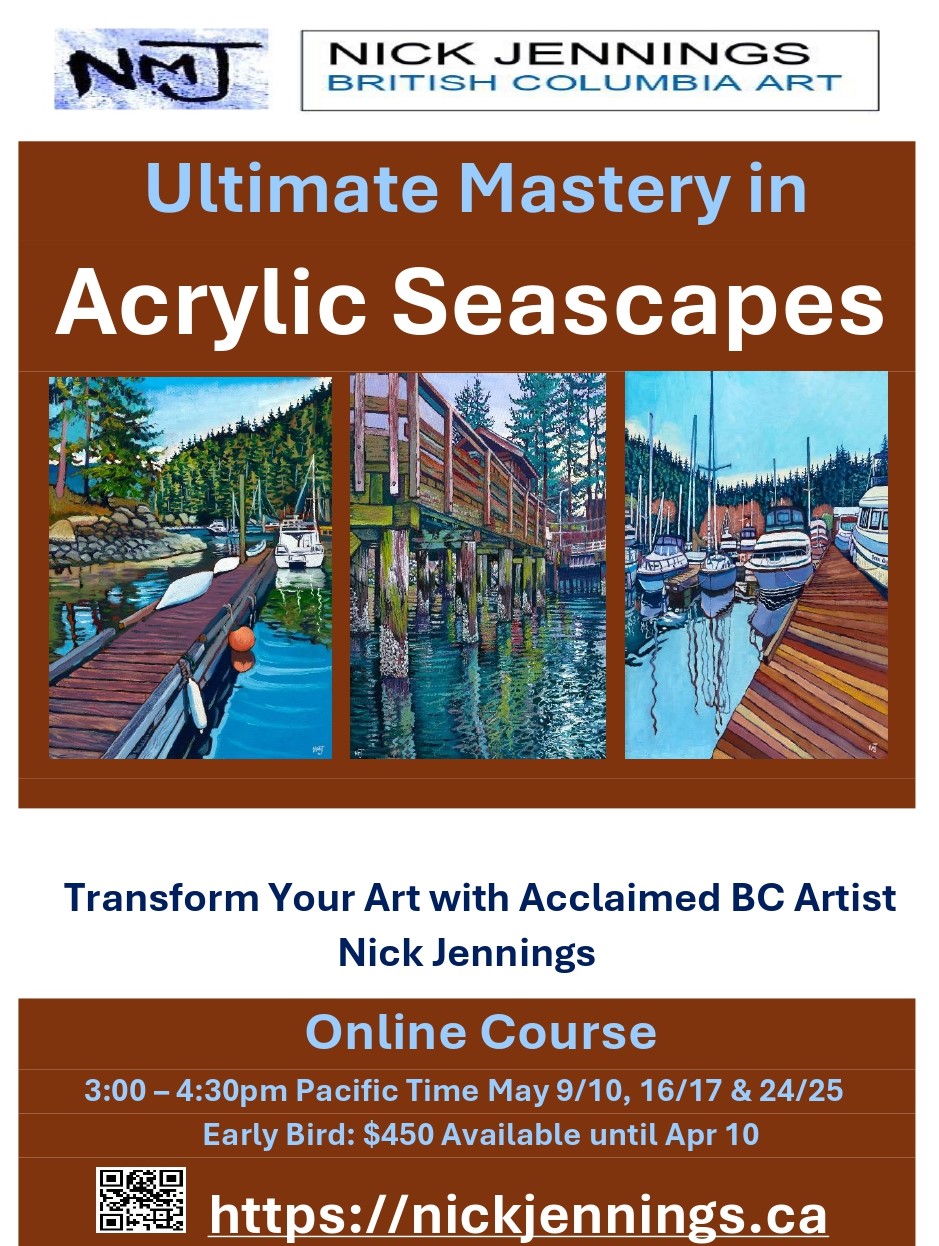
Level 3: Ultimate Mastery in Acrylic Seascapes
$450.00
Ultimate Mastery in Acrylic Seascapes
Live online course with Nick Jennings
This course comprises six 90-minute classes spread over three weekends. This course builds on the knowledge and experience gained on the first two courses and ties everything together to establish your overall expertise at painting beautiful seascapes that are rich in personal expression and detail. Among the areas covered are: how to paint horizons, how to paint sky including clouds and sunsets, how to paint ocean detail, waves, water patterns and reflections, how to paint trees, seagulls, cliffs, boats and docks. and how to build colour and detail into existing elements.
May 9 & 10 + May 16 & 17 + May 24 & 25
3:00 – 4:30 pm
Video recordings will be supplied after each session
Description
Level 3: Ultimate Mastery in Acrylic Seascapes: Syllabus
Recommended Materials:
• Acrylic Paints: at least all the primary colours of any brand, but not inferior to say, Artist’s Loft
• Paintbrushes: starter kit specific to acrylic paints
• Ruler
• Pen or pencil
• Canvas: Three pieces. 20 x 24-inch canvas is a good size to start with, but smaller is also fine for Days 4 and 5. You can also buy canvas prints at thrift stores that you can paint over. Ideal but not essential: prime your canvas first with a light colour of paint and leave to dry (you can even use emulsion house paint)
• Water jar
• Palette (can be a frisbee or for example recycled margarine containers)
• Drop Cloth to protect your carpet
• Table surface or artist easel
• Old clothes that you don’t mind getting covered in paint!
• A heater that it’s safe to lean your painting in front of for a quick dry
Itinerary – Day 1: Horizon and Sky
Overview of skills transformation in Day 1:
By the end of Day 1 you will know how to:
• enhance horizon light to contrast it with sea and land
• use the cut-out method for clouds, trees and horizon details
• create a quick and effective rainy sky
• create a circular firmament
• graduate sky colours from light to dark
• paint quick and easy sunsets
Tip of the day:
What the sky is doing at any given moment is a combination of many factors; skies are eccentric, fleeting and always unique, and so paint in a non-rigid way. Being erratic, frenzied and sporadic in your brush strokes can help the sky to express itself more fully.
• Introduction – getting to know you *This course follows on from Level 2, but it’s possible there will be students joining for the first time and some brief preliminaries may therefore be needed.
• Making the sky glow on the horizon
• Applying the cutting-out method for maximum effect
• Creating a surprisingly effective rainy sky in no time at all
• Painting the sky as circular rather than linear
• Blending sky colours from dark to light
• Painting sunsets
Itinerary – Day 2: Ocean Detail Part 1
Overview of skills transformation in Day 2:
By the end of Day 2 you will know how to:
• express receding shore-to-horizon distance in your ocean`
• add shade and light to water patterns
• bring out the muscular patterns of waves using heavy and light tones
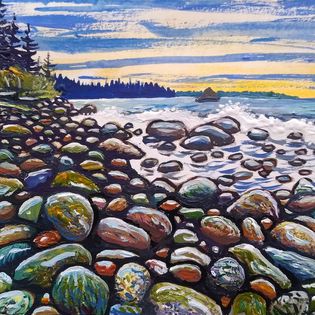
• paint foamy waves breaking on the shore
• create a wet look for your stones and rocks
Tip of the day:
On close examination and by zooming into photos, you will quickly see the rich smorgasbord of colour tones that exists in ocean water. Always seek to extend your palette as far as it will go when painting water.
• Creating water effects that expand distance between horizon and shore
• Brush strokes that suggest ocean movement and delineate dark and light water
• Creating effective wave patterns using shading and light
• Accentuate the power and ferocity of raging surf
• Painting the foamy patterns left by receding waves on the shore
• Giving stones and rocks a wet look
Itinerary – Day 3: Ocean Detail Part 2
Overview of skills transformation in Day 3:
By the end of Day 3 you will know how to:
• break up water with rocks
• reflect sky and sun in water
• identify the colours of sea water and mix paint to create those colours
• focus on and bring your viewer’s eye to close up water patterns
Tip of the day:
The more you look at the way light is reflected in water, the more colours you will see. For example, I often see violet when observing light reflections in water.
• Breaking up shore water with prominent rocks
• Bringing out subtle sky colours in water, including sun splashes
• Mixing and painting water colours through a close investigation of nuance
• Focusing on water detail in your foreground
Itinerary – Day 4: Trees, Cliffs, Islands
Overview of skills transformation in Day 4:
By the end of Day 4 you will know how to:
• paint a receding tree line
• paint coniferous and deciduous trees
• paint cliffs
• paint islands and tree clusters on the beach
Tip of the day:
You should paint in the old before adding the new (the light) on top.
• Painting lines and clusters of trees against the sky as they fade into the distance
• Applying methods for tapering the tops of trees
• Painting cliffs
• Painting tree clusters on the beach, and painting islands and promontories
Itinerary – Day 5: Docks and Seagulls
Overview of skills transformation in Day 5:
By the end of Day 5 you will know how to:
• map out and paint docks
• blend docks in with natural elements using barnacles, shell clusters, seaweed
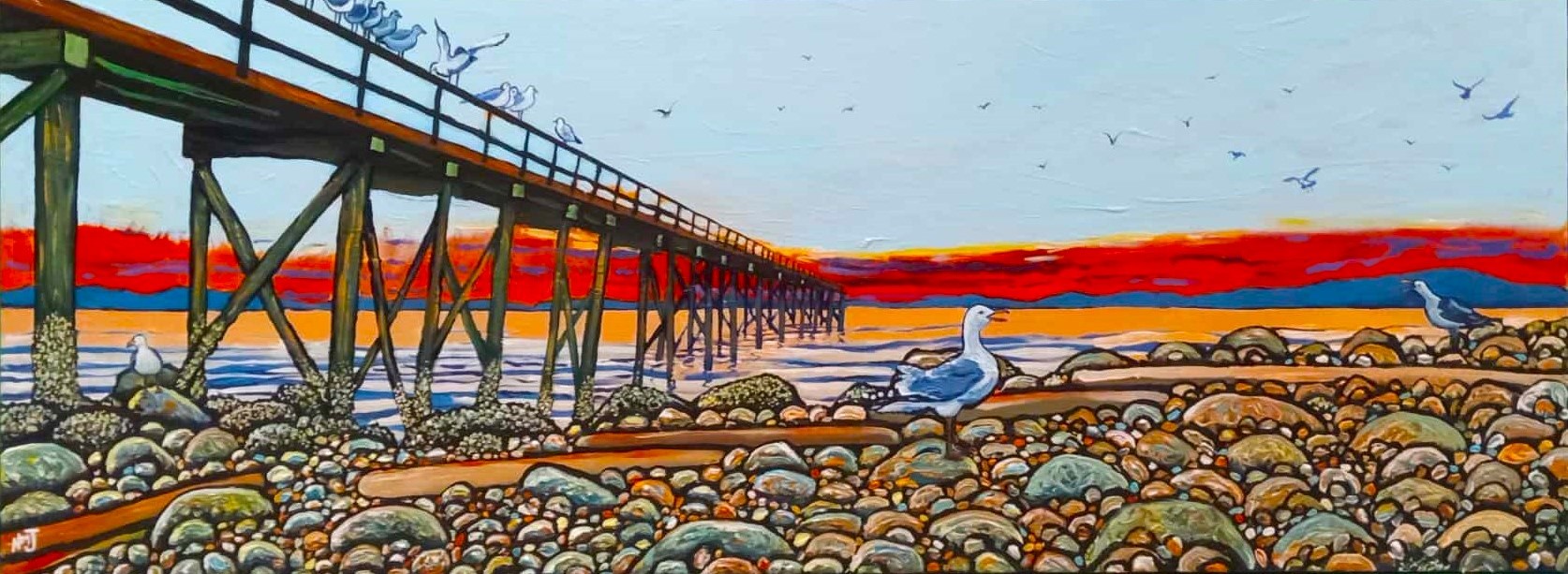
• draw and paint solitary and grouped seagulls
Tip of the day:
When your ocean is calm, you may wish to add seagulls to contrast stillness with movement. When your ocean is a swirling mass of waves, you may also want to add seagulls to accentuate movement and atmosphere!
• mapping out a dock using a ruler and painting the outline
• Painting barnacles, mussel clusters and seaweed that root your dock to the beach
• Drawing and mapping seated, clustered and flying seagulls
Itinerary – Day 6: Boats and Reflections
Overview of skills transformation in Day 4:
By the end of Day 6 you will know how to:
• draw and paint individual and grouped boats
• paint rigging and masts
• paint boat reflections in water
Tip of the day:
You should paint in the old before adding the new (the light) on top.
• Mapping out and painting a boat or boats using a photo source
• Mapping out and painting rigging and ropes
• Painting reflections that reflect boat details, sky and surrounding detail
• Sharing our paintings and discussing “aha” moments