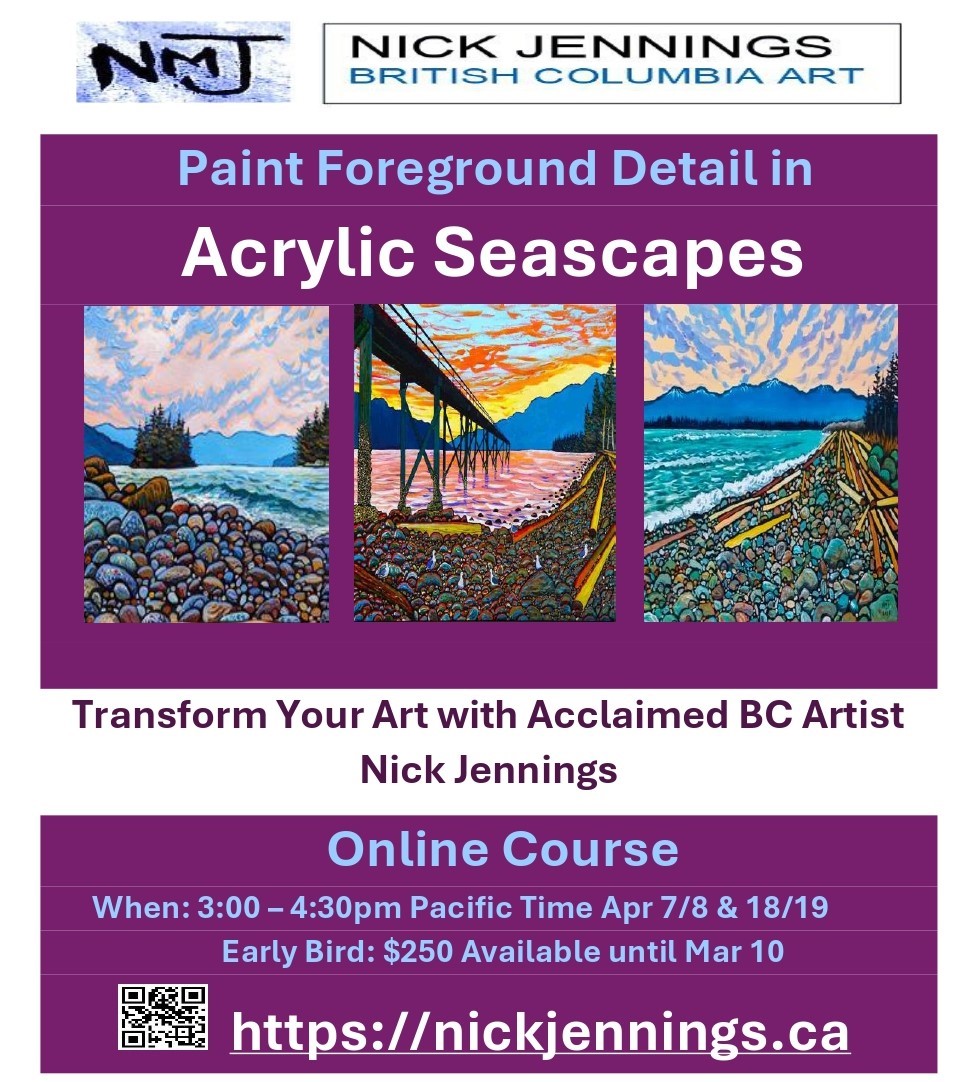
Level 2: Paint Foreground Detail in Acrylic Seascapes
$250.00
Paint Foreground Detail in Acrylic Seascapes
Live online course with Nick Jennings
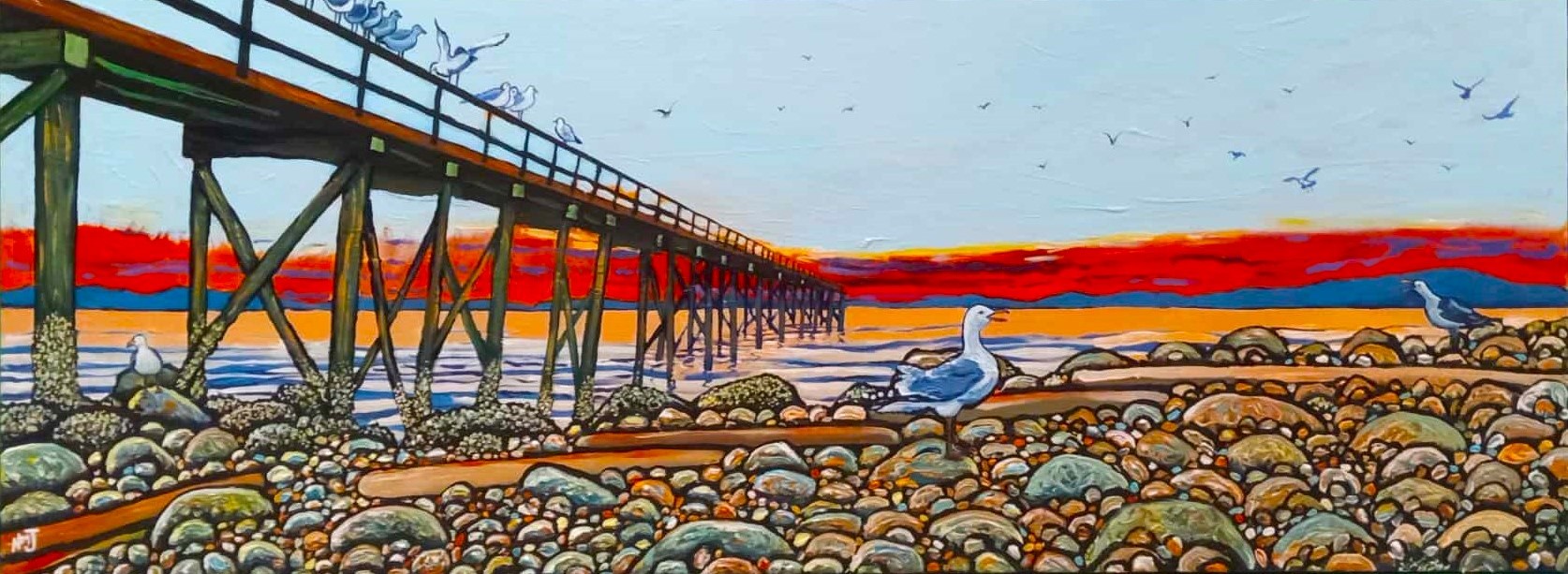
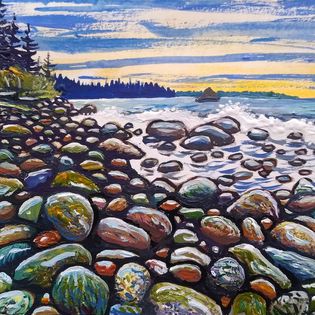
This course comprises four 90-minute classes spread over two weekends. Foreground detail is where the eyes go when people view your art, so let’s get skilled at it! You will learn how to paint rocks, driftwood, barnacles, frayed rope, rusty chains and seaweed. You will also develop your own personal approaches to detail, colour mixing and light patterns in relation to these foreground details. You will come away with true confidence, competency and enthusiasm for creating mesmeric shoreline detail.
April 11 & 12 + April 18 & 19
3:00 – 4:30 pm
Video recordings will be supplied after each session
Description
Level 2: Paint Foreground Detail in Acrylic Seascapes Syllabus
Recommended Materials:
• Acrylic Paints: at least all the primary colours of any brand, but not inferior to say, Artist’s Loft
• Paintbrushes: starter kit specific to acrylic paints
• Ruler
• Pen or pencil
• Canvas: 20 x 24-inch canvas is a good size to start with. You can also buy canvas prints at thrift stores that you can paint over. Ideal but not essential: prime your canvas first with a light colour of paint and leave to dry (you can even use emulsion house paint)
• Water jar
• Palette (can be a frisbee or for example recycled margarine containers)
• Drop Cloth to protect your carpet
• Table surface or artist easel
• Old clothes that you don’t mind getting covered in paint!
• A heater that it’s safe to lean your painting in front of for a quick dry
Itinerary – Day 1: Rocks & Stones part 1
Overview of skills transformation in Day 1:
By the end of Day 1 you will know how to:
• choose eye-catching subject matter to paint
• effectively map and plan out your foreground
• include three general sizes of stones and rocks in your foreground
• create a sense of scale and distance
Tip of the day:
There is nothing uniform about rocks on a beach; always jumble shapes and sizes together and be consistent about it.
• introduction – getting to know you *This course follows on from Level 1, but it’s possible there will be students joining for the first time and some brief preliminaries may therefore be needed.
• grasping the concept (class discussion): discussing stand-out details of a photo
• choosing your subject matter
• blocking off and preparing foreground
• scale and perspective: from close-up to farther away
• outlining shapes to establish foreground elements
• perspective and establishing scale
• a reminder of light vs dark (“values”)
Itinerary – Day 2: Rocks & Stones part 2
Overview of skills transformation in Day 2:
By the end of Day 2 you will know how to:
• Use stones and rocks to distribute colour
• add shade and light to rocks and stones
• tie in sky colour with light on rocks
• fade out detail as it gets further away
• create a wet look for your stones and rocks
Tip of the day:
Stones are almost never one colour, and individual stones and rocks often have dozens of colours.
• sharing our paintings so far
• discussing several photos to brainstorm details, characteristics, colours
• creating 3D stones and rocks with shading and light
• aligning light and colour with sky colour
• creating natural perspective through fading out details
• giving stones and rocks a wet look
Itinerary – Day 3: Driftwood and Barnacles
Overview of skills transformation in Day 3:
By the end of Day 3 you will know how to:
• plan and paint driftwood, sticks, leaves, rotting wood
• paint and layer barnacles on rocks and other surfaces
• distribute features across your entire foreground for more authenticity
Tip of the day:
Beaches are living ecosystems embodying perpetual cycles of renewal, adaptation and decay. It is an artist’s job to incorporate these themes.
• identifying “scattering” patterns of driftwood
• mapping out driftwood
• painting wood details and colours
• adding light and shade to driftwood
• painting and layering barnacles on fixed objects
• ensuring consistency across your foreground
Itinerary – Day 4: Detritus, Puddles & Seaweed
Overview of skills transformation in Day 4:
By the end of Day 4 you will know how to:
• create details suggestive of age and decay
• paint human-made detritus that blends in with natural elements
• paint seaweed clusters on rocks
• paint puddles
Tip of the day:
You should paint in the old before adding the new (the light) on top.
• identifying human-made detritus in a photo and how it blends into the natural environment. Brainstorming other examples of human-made objects we may find on beaches
• mapping out and painting chains and ropes affixed to objects commonly found.
• painting clusters of seaweed
• painting puddles that reflect sky and surrounding detail
• sharing our paintings so far and discussing “aha” moments